WARNING: This product contains nicotine. Nicotine is an addictive chemical.


NEWSLETTER
Get special offers and find out what's new in the store. Sign up for the EV newsletter.WARNING: This product contains nicotine. Nicotine is an addictive chemical.
NEWSLETTER
Get special offers and find out what's new in the store. Sign up for the EV newsletter.Posted: October 29, 2026

"Fuzzy feet" is one of those sayings that sound cute, but has a radically different meaning than what it implies, especially when applied to the cigar industry. Like most cigar enthusiasts can attest, a stogie is best enjoyed after its maturation period in a humidor. The temperament in this moisture controlled environment is somewhat mild, and keeps cigars fresh at a 65% to 72% relative humidity range. When left unattended, particularly in a sun exposed and moisture rich environment, a cigar is at risk of developing fuzzy feet which is a phenomenon where the bottom of a cigar, a.k.a. "the foot," develops a powdery white appearance that resembles fuzz.
Those fuzzy feet that look almost cartoon-like are in fact mold spores. Like any organic matter sitting in a moist climate, cigars are vulnerable to mold overgrowth. As a result, the wet environment that makes cigars thrive can also be their downfall.
Fuzzy feet is one of those incidents that happen to most cigar novices at some point or another. While you technically can't reverse a mold infestation in your cigar collection, you can take steps to prevent it from happening to begin with. Cigars are finicky as they need a perfect temperature and climate to survive. If placed in a dry environment they will fall apart, lose taste and flammability. Too wet and the cigar is now home to an infestation of mold monsters.
Like food, you can tell when a cigar has spoiled as it develops a mildewed odor, and a swollen appearance. A healthy cigar should be a combination of squish with resistance. Oversaturated with moisture and a cigar will be mushy to the touch, and undersaturated it will be brittle. You want to be like Goldilocks and find the perfect resting temperature for your cigar collection. In order to do this you'll need to invest in a humidor and humidity control packets.
If you're new to the cigar world, a travel humidor like the Lotus 5 Cigar Travel Humidor or the Xikar 5 Cigar Travel Humidor is a smart pickup if you only have a few cigars to keep fresh. Boveda packs like Boveda 69% RH Humidity, Boveda 72% RH Humidity, and Boveda 84% RH Humidity are essential for humidity regulation, and they work using two-way humidity control technology. The packet contains a salt solution that holds a fixed relative humidity. If your cigars' environment gets too humid, the pack absorbs the excess moisture, and if it gets too dry the pack releases moisture back into the air. That constant regulation is what keeps your cigars sitting right in their ideal range.
Cigar mold goes by many names: fuzzy feet and cheese being the most common. Not to be confused with the terms bloom and plume, which describe the crystallization of oils and sugars on cigar wrappers. They appear as a fine granular-like dust, and you simply brush it off before you smoke the cigar. Unlike fuzzy feet, bloom on a cigar signifies its maturation and proper storage in a humidor. Next time you hear cigar enthusiasts talking about the bloom or bloom on their cigars, it's a good sign, and means that they followed the proper protocol in ensuring that the smoke will be aged to perfection.
Spotting the difference between fuzzy feet and bloom on a cigar can be tricky. At first glance they may look similar, but fuzzy feet is a thick, puffy white, green, or blue fuzz that pops in clusters on a cigar. Bloom, on the other hand, tends to spread evenly across the wrapper, as if someone just dusted it on.
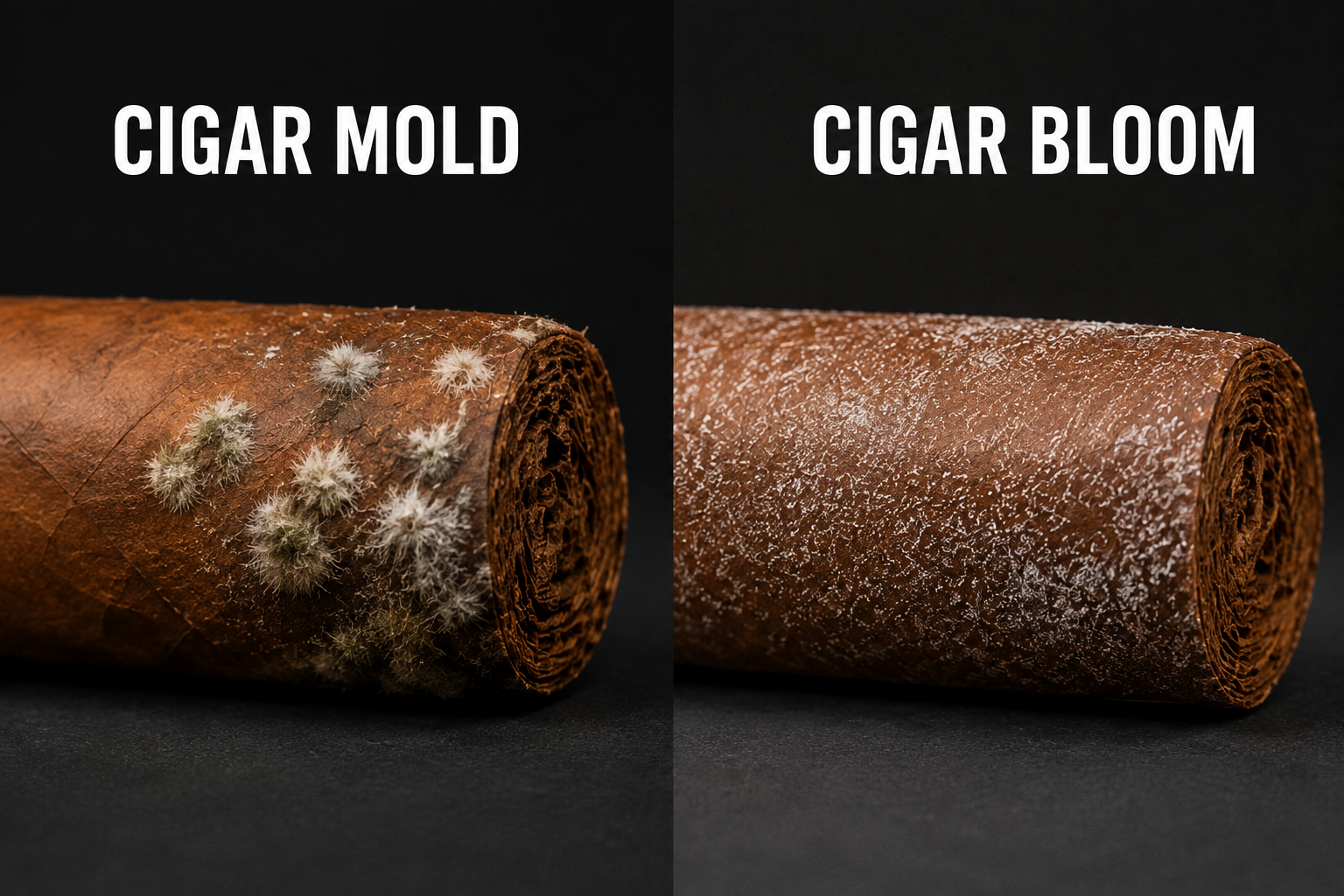
It's important to note that lots of people don't subscribe to the notion of bloom and plume. Many people argue that it's just mold in its early stages. As a cigar connoisseur I can say that I've never come across bloom on my stogies, but that could also be because I don't let them age for too many years in my humidor. I'm someone that lacks patience. So after a year or two I'm smoking my favorites, they don't sit for longer than that. But some people claim that bloom is an essential indicator of proper aging. I like to use all my senses instead to determine if my cigars are ready to smoke.
The smell of the cigar is also a good indicator of how fresh it is. Bloom-covered cigars will smell like the tobacco blend inside the wrapper (so the data suggests), whereas moldy cigars will have a distinct foul odor.
Bloom and mold might look alike, but they're definitely not the same thing and shouldn't be treated as such. You don't want to mitigate bloom, but you will want to get rid of mold. Here are 5 steps to keep your cigars fuzzy feet-free:
As we've covered, storing your cigars properly is the best way to avoid mold altogether. However, there are factors worth noting which cause humidor humidity swings such as bad seals, cheap hygrometers, and cedar storage that hasn't been properly seasoned. All of these are pretty out of your control, but acknowledging that these factors affect your smoking experience can dramatically aid you in spotting issues before they develop into a bigger problem.
You may be wondering what a seasoned humidor is, and it's actually quite interesting in the fuzzy feet lore. Any new humidor straight from the packaging is bone dry, especially if your humidor is made from cedar wood. What you'll want to do is put Boveda Packs in the new humidor and let it rest for two weeks with the lid shut before introducing your cigars to their new home. You want the humidity to be roughly 80% before adding your stash to the box. Once inside, replace the Boveda Packs with fresh ones and you should be good to go.
Not seasoning your humidor won't introduce fuzzy feet, instead it will actually have the opposite effect and completely dry out your cigars before you have a chance to smoke them. That's why seasoning is so important in getting the right first step in your cigar smoking process. If your humidor has a hygrometer, it is also essential that you calibrate it, however, not all humidors come with a hygrometer, especially if it's a travel case or the like. To calibrate your hygrometer, use either the paper towel test or the salt test.
Paper Towel Test: Wrap your hygrometer in a lightly damp paper towel and let it sit for 30-45 minutes. If it reads 100%, you're good. If not, take note of how far off it is because that's your correction number going forward.
Salt Test: Pour some table salt into a small container, dampen it just enough that it's not fully dissolved, then seal your hygrometer in there for 5-6 hours. A properly calibrated hygrometer should read 75% RH. Whatever it actually reads, the gap between that and 75% is your offset, so just adjust your future readings by that amount.
Mold loves to grow in a moisture-rich environment that is warm, which is why when your humidor reaches 72% RH it becomes a threat to your cigar health. Mold also thrives in stagnant air, which is why it is a common issue in the cigar industry. While essential, humidors, when left unregulated, are the perfect breeding grounds for mold, as they sometimes have poor air circulation and tight living spaces for the cigars.
Where there is mold there is also most likely tobacco beetles.
The two fastest ways to kill your cigar collection are with a mold infestation and a tobacco beetle infestation. The same conditions that make mold grow provide the ideal environment for tobacco beetle larvae to hatch. Pretty much all tobacco leaves at some point in their life have beetle eggs on them, and when processed go through a heating process to kill them off. However, with the right conditions the beetle larvae can hatch and create mini holes in your cigars.
This is a surefire indicator that you have an infestation. With fuzzy feet, there's no way around it; you have to throw away your cigars that are affected. However, with the case of tobacco beetles it's a little different. When you notice them, you still have to clean out your humidor, disinfecting it from all the larvae.
Then the cigars with beetle bites in them, you should freeze to kill off the live larvae. Wait at least 6 days before taking them out of the freezer. This will ensure that the larvae are fully killed off. If not, one egg will start the whole process again.
Temperature control is so important, lest you get bugs and mold and just overall poor conditions for your cigars to live.
That's why I always recommend starting your cigar collection small. It's easier to manage, and if an outbreak of fuzzy feet or beetles creeps up on you, it's way easier to rectify the issue on a small scale as opposed to a fully stacked humidor with mold and bugs galore. Compared to houseplants, cigars are far more forgiving, and a much yummier hobby than taking care of a potted plant. Keep on taking care of your collection, and you'll be rewarded with a bountiful smoke of yummy Virginias and Orientals. If not, then the buggies and fuzzies will sour your smoke.
Smoke up and smoke out.
0 Comment
Latest

