WARNING: This product contains nicotine. Nicotine is an addictive chemical.


NEWSLETTER
Get special offers and find out what's new in the store. Sign up for the EV newsletter.WARNING: This product contains nicotine. Nicotine is an addictive chemical.
NEWSLETTER
Get special offers and find out what's new in the store. Sign up for the EV newsletter.You’ve probably started seeing “Metatine” show up on product labels, but what exactly is it? Is it nicotine? Is it safe? Is it legal? This guide breaks down everything you actually need to know, without all the mumbo jumbo.
Metatine is a synthetically derived molecule designed to behave similarly to nicotine in the body, but it is chemically distinct from nicotine and is not sourced from tobacco plants. It was developed using patented manufacturing technology and proprietary processes, and the finished product contains no nicotine.
In plain terms: imagine nicotine and Metatine as two keys that fit the same lock. They’re not identical keys, but they open the same door in your brain, specifically, receptors called nicotinic acetylcholine receptors (nAChRs). When these receptors are activated, your brain releases dopamine (associated with reward and pleasure), as well as noradrenaline and serotonin, which play roles in mood regulation and stress relief.
That’s why consumers of Metatine-based vapes often report a sensation that feels very similar to conventional nicotine products. The same satisfaction, the same throat feel, the same sense of calm.
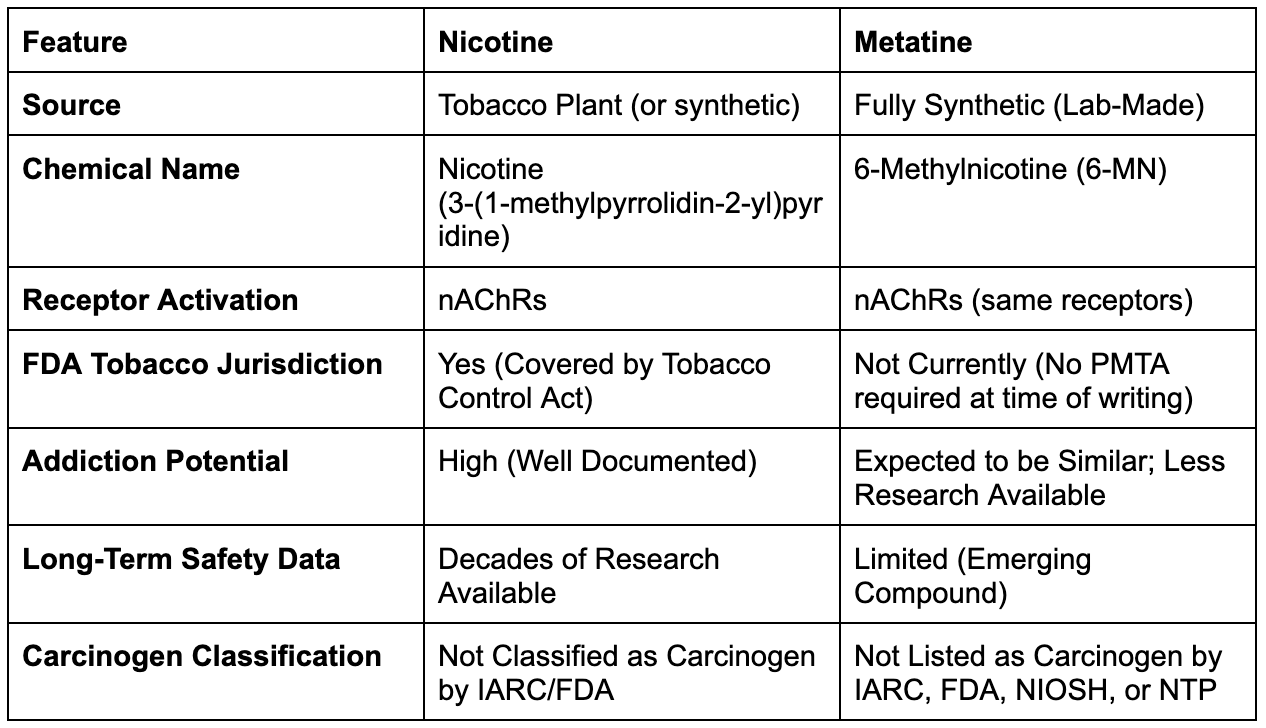
Metatine is produced in a laboratory setting through a patented synthesis process. Critically, the starting material is not nicotine, and the finished molecule is distinct enough to be classified as a separate compound. The technical name most commonly associated with Metatine is 6-methylnicotine (6-MN), a nicotine analogue that has a methyl group added at the 6 position of the pyridine ring (think of the key analogy again).
The structural difference between is small but significant: it’s what separates Metatine from nicotine both chemically and, crucially, from a regulatory standpoint.
It helps to lay this out clearly, so here’s a straightforward comparison:
Metatine is the core active ingredient in several vaping product lines that have gained popularity in the U.S. market. The most prominent brand is SPREE BAR, developed by Charlie’s Holdings, which launched one of the first widely distributed Metatine-based disposable vape systems. The SBX Metatine 25000 is a more recent example. A high-capacity rechargeable disposable featuring dual mesh coils and multiple power modes.
Other brands are starting to follow this trend by releasing disposable vapes and e-liquids using nicotine alternative e-liquids.
Here’s where it gets interesting and where you should pay close attention. The FDA’s authority over tobacco products extends specifically to nicotine and tobacco-derived substances. Because Metatine is a synthetic compound that is chemically distinct from nicotine, the manufacturer argues it does not meet the definition of nicotine under the Family Smoking Prevention and Tobacco Control Act.
In practice, this means Metatine-containing products have not required a Premarket Tobacco Application (PMTA), the lengthy FDA approval process that has restricted the sale of many conventional vapes in recent years. Now products containing Metatine have been marketed as “PMTA-exempt.”
However, regulators are watching closely. A May 2024 Reuters investigation highlighted rapid expansion of nicotine analogues like 6-MN in the U.S. market, and the FDA has publicly flagged concerns about potency and youth access. State-level regulations are also evolving: some states have broad vapor product laws that may apply to Metatine products regardless of nicotine status, and the regulatory landscape is likely to shift.
Note: Regulations on Metatine products vary by state and are actively changing. Always check your local laws before purchasing. This article is for informational purposes only and does not constitute legal or medical advice.
This is the most important question and the most honest answer is that the full picture is still emerging.
Throught manufacturers, Metatine has been tested for tobacco-specific nitrosamines (TSNAs), chemical impurities, and volatile organic compounds, with results indicating that there is no additional risk compared to existing vape additives.
However, because Metatine is structurally similar to nicotine, its toxicity profile is expected to be similar as well, and nicotine is considered acutely toxic in sufficient quantities. More importantly, long-term human studies on Metatine do not yet exist at the scale available for nicotine. The compound is new, and independent research is limited.
No. Synthetic nicotine is still nicotine, just made without tobacco. Metatine is a different molecule entirely (6-methylnicotine), which is why it sits outside the regulatory definition of nicotine under the current federal law.
Almost certainly, yes. Because it activates the same nicotinic acetylcholine receptors in the brain as nicotine, it carries a similar dependence potential. Manufacturers acknowledge this, and products carry addiction warning.
Standard nicotine tests look for cotinine, a metabolite of nicotine. Since Metatine is a different molecule, it may metabolize differently, but research on how it breaks down in the body is still limited. We can’t say definitively either way.
It depends on where you live. At the federal level, Metatine products are not currently classified as tobacco products. But some states define vapor products broadly enough to encompass non-nicotine compounds. Check your state’s specific vapor product laws, and note they are actively evolving.
Metatine products are intended only for current adult smokers and vapers aged 21 and over. They are not for minors, non-smokers, people who are pregnant or breastfeeding, or anyone looking to quit tobacco or nicotine use.
Metatine is a genuinely novel ingredient in the vaping space; a lab-synthesized molecule engineered to deliver a nicotine-like experience through the same brain receptors, without being derived from nicotine or tobacco. For adult vapers navigating a market where flavor restriction and regulatory hurdles have limited options, Metatine represents a legitimate new category of product.
That said, it’s not without unknowns. The science of its long-term effects in humans is still in early stages, addiction potential is real, and the regulatory landscape is in flux. As with any new vaping ingredient, informed choices matter.
At Element Vape, we believe in giving our customers the clearest, most accurate information available, so you can make the call that’s right for you.
If you would like to explore further, check out our collection of nicotine alternatives.
0 Comment
Sam is a music lover, snack enthusiast, and self-appointed arugula ambassador who somehow turned all of that into a whole career in writing. Fueled by all the comforts in life and an inexplicable obsession with the spiciest leaf in the salad game, she brings the same chaotic passion to every article that she brings to her own life.
Latest


