WARNING: This product contains nicotine. Nicotine is an addictive chemical.


NEWSLETTER
Get special offers and find out what's new in the store. Sign up for the EV newsletter.WARNING: This product contains nicotine. Nicotine is an addictive chemical.
NEWSLETTER
Get special offers and find out what's new in the store. Sign up for the EV newsletter.Some cigar names are invented for marketing purposes. Others are borrowed from history, and San Cristobal falls firmly into the second category. The name reaches all the way back to 1519, when Spanish conquistador Pánfilo de Narváez founded the city that would eventually become Havana, naming it San Cristóbal de la Havana in honor of Saint Christopher, the patron saint of travelers. Centuries later, that same piece of Cuban history became the inspiration for one of the more respected Nicaraguan-made cigar lines on the modern market.
San Cristobal as we know it today is the product of a genuine partnership between two major names in the cigar world: Ashton, the Philadelphia-based company known for decades of quality Dominican cigars, and Jose “Pepin” Garcia, the legendary Cuban-born blender behind My Father Cigars. This guide covers the history behind the name, how the brand came together, and which lines you should know before your next humidor run.
To understand San Cristobal, it helps to understand the name’s origin first. When Havana was founded in the early 16th century, it was christened San Cristóbal de la Habana, a name that combined Saint Christopher with “Habana,” a word likely derived from Habaguanex, the name of the indigenous Taíno chief who controlled the region at the time. Havana would go on to become the beating heart of the Spanish empire’s presence in the Americas and, eventually, the single most famous cigar-producting city in the world.
The San Cristobal name had actually been used once before on a cigar brand prior to the Cuban Revolution, though that version disappeared after Castro’s government nationalized the island’s tobacco industry. In 1999, Habanos S.A. revived the name for an entirely new, unrelated Cuban marque, paying tribute to Havana’s colonial roots and naming individual vitolas after the historic forts that once defended the city. That Cuban version remains a separate, Cuba-only release to this day and isn’t available in the United States.
The San Cristobal sold at Element Vape and other U.S. retailers takes its name from that same deep well of Havana history, but it’s a completely separate non-Cuban brand with its own story.
By the mid-2000s, Ashton had already spent two decades building one of the most respected reputations in the Dominica cigar world, largely through its long-running partnership with the Fuente family. But the Levin family, who’ve run Ashton since Robert Levin founded it in 1985, wanted to explore what a serious Nicaraguan blend might look like under their name.
They found their answer in Jose “Pepin” Garcia. By the time Ashton came calling, Pepin had already built a formidable reputation of his own, having moved from Cuba to Nicaragua in the early 2000s and quickly become one of the most sought-after blenders in the industry. According to Ashton’s own account of the partnership, the moment they met Pepin, they knew he was exactly the right collaborator to bring a new Nicaraguan project to life. The timing lined up well, too: Pepin had just been named “America’s Hottest Cigar Maker” by Cigar Aficionado, and his reputation for bole, meticulously constructed cigars was exactly what Ashton was looking for.
San Cristobal officially launched in 2007, blended collaboratively by Pepin Garcia, his son Jaime, and Manny Ferrero, Ashton’s longtime vice president of sales. The cigars have been handmade ever since at the Garcia family’s My Father Cigars factory in Estelí, Nicaragua, using tobacco grown largely on the family’s own farms in Estelí and Jalapa. Outside the United States, Ashton’s version of San Cristobal is sold under the name Paradiso to avoid confusion with Cuban marque.
A genuine collaboration between two respected families. San Cristobal brings together Ashton’s decades of refinement and market expertise with the Garcia family’s renowned Nicaraguan blending skill, giving the brand a distinct identity shaped by two very different cigar-making traditions.
Real range across the portfolio. From the milder Elegancia to the considerably bolder Quintessence and limited Ovation, San Cristobal offers genuine variety in body and intensity, all while maintaining the construction quality the Garcia family is known for.
Meticulous, hands-on production. Every San Cristobal release is handmade at the Garcia family’s own factory using tobacco grown largely on their own farms, keeping the entire process close to the source rather than relying on outside suppliers.
A name with real historic weight. Unlike brands that invent a backstory for marketing purposes, San Cristobal’s name connects directly to one of the most significant cities in cigar history, giving the brand a sense of heritage that goes beyond the blend itself.
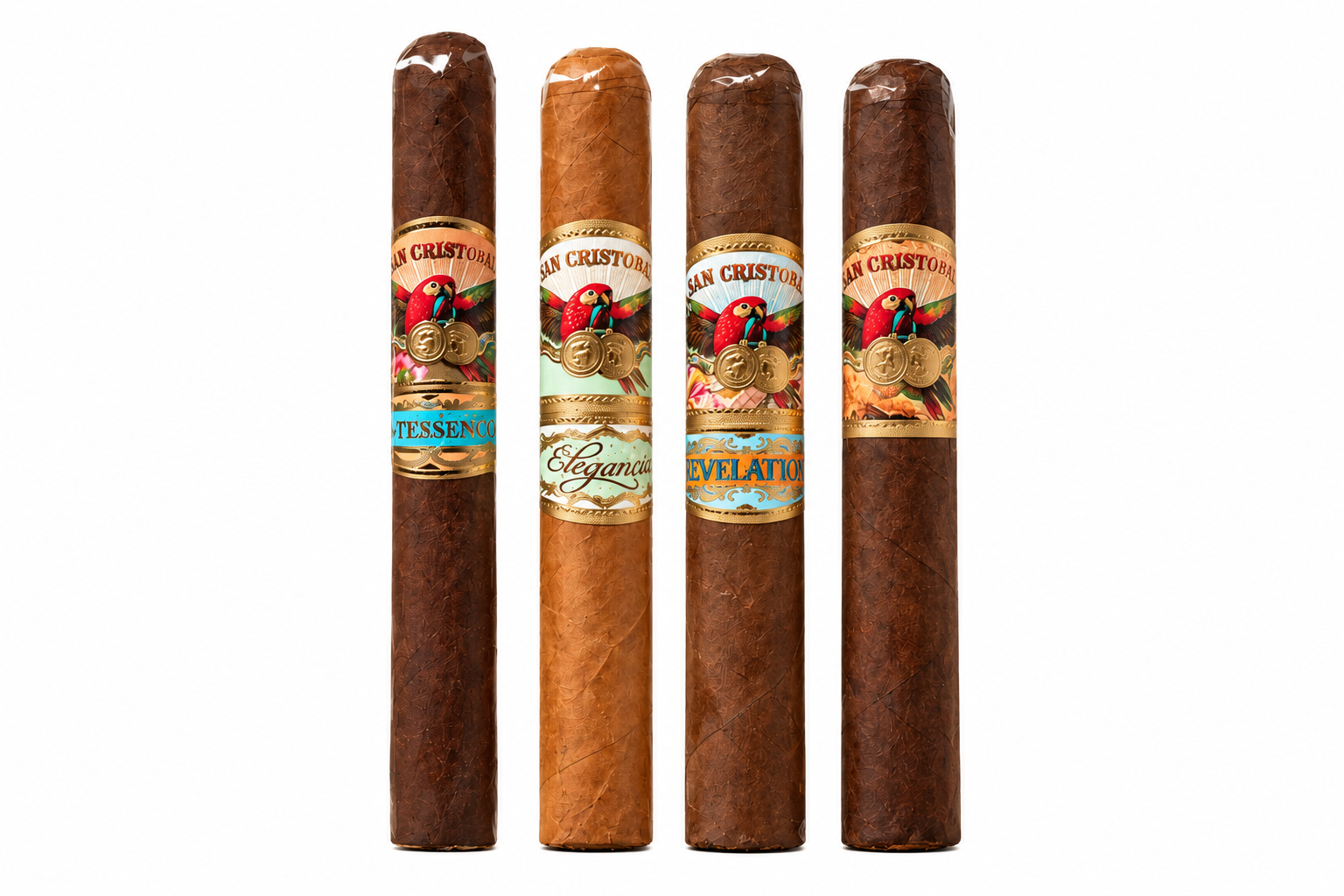
The cigar that started it all, the original San Cristobal blend is one of the more powerful releases in the portfolio, built from aged Nicaraguan tobaccos under a rich, dark wrapper. Despite its strength, It’s known for remaining notably smooth and well-balanced rather than overwhelming making it a favorite among smokers who already enjoy Pepin Garcia’s signature style.
A gentler counterpart to the original blend, Elegancia uses a Blonde Connecticut-seed, Ecuadorian-grown wrapper and offers a mild-to-medium bodied, notably smooth and nutty smoking experience. It’s often considered the most approachable entry point into the San Cristobal lineup and remains one of its most consistently top-rated releases.
One of the brand’s most celebrated additions, Revelation uses a milk chocolate-hued Ecuadorian Sumatra wrapper, reportedly the same wrapper varietal used on Ashton’s acclaimed VSG line, grown from a lower priming for a lighter color and a somewhat different flavor profile. It delivers a rich medium-bodied smoke with the real balance and complexity, and it made a significant splash in the industry upon release, quickly becoming one of the brand’s most popular blends.
A bolder, full-bodied addition to the lineup, Quintessence wears an Ecuadorian Habano wrapper and leans into the spicier, more intense side of Pepen Garcia’s blending style. For fans of Pepin’s signature boldness, Quintessence and the original blend tend to feel the most familiar.
A limited-edition release within the portfolio, Ovation features a San Andrés Oscuro wrapper that undergoes an intensive two-and-a-half-year double fermentation process, poured with Nicaraguan binder and filler tobacco harvested exclusively from Garcia family farms. It’s an opulent, rare release built from some of the finest tobacco available to the Garcia family, created in honor of the brand’s growing reputation.
Start with Elegancia if you’re newer to full-bodied Nicaraguan cigars. Its milder, nuttier profile offers an approachable way into the brand.
Try Revelation for a well-balanced, widely celebrated option. It’s one of the most popular and critically respected releases in the portfolio.
Go with the Original or Quintessence if you already love bold, spicy cigars. Both lean into the intensity Pepin Garcia is best known for.
Seek out Ovation for something special. Given its limited availability and lengthy fermentation process, it’s a cigar worth savoring on a notable occasion.
No. While the name references Havana’s original colonial name, the San Cristobal sold in the United States is a completely separate, non-Cuban brand made in Nicaragua through partnership between Ashton and the Garcia family of My Father Cigars. A different, Cuba-only San Cristobal de la Habana brand exists separately under Habanos S.A. and is not related or available in the U.S.
San Cristobal is handmade at the Garcia family’s My Father Cigars factory in Estelì, Nicaragua, under the direction of Jose “Pepin” Garcia and his son Jaime, and then distributed by Ashton.
Elegancia is generally considered the mildest release in the San Cristobal portfolio, offering a smooth, nutty, medium-bodied profile that’s more approachable than the brand’s bolder offerings.
San Cristobal manages to pull off something relatively rare in the cigar world: a name steeped in centuries-old history, paired with a modern blend built by two of the most respected names in the business. From the approachable Elegancia to the bold, rarely available Ovation, every release in the portfolio reflects the Garcia family’s renowned craftsmanship and Ashton’s decades of refined taste.
If you’re new to the brand, start with Eleganca or Revelation to get a feel for the San Cristobal style, then work your way toward the bolder Original and Quintessence as your palate develops. Given the history behind the name alone, there’s something satisfying about lighting one up and knowing exactly how far back the story really goes.
Check out our collection of San Cristobal Cigars
0 Comment
Sam is a music lover, snack enthusiast, and self-appointed arugula ambassador who somehow turned all of that into a whole career in writing. Fueled by all the comforts in life and an inexplicable obsession with the spiciest leaf in the salad game, she brings the same chaotic passion to every article that she brings to her own life.
Latest