WARNING: This product contains nicotine. Nicotine is an addictive chemical.


NEWSLETTER
Get special offers and find out what's new in the store. Sign up for the EV newsletter.WARNING: This product contains nicotine. Nicotine is an addictive chemical.
NEWSLETTER
Get special offers and find out what's new in the store. Sign up for the EV newsletter.Perdomo cigars have become a fixture in the cigar world, slowly climbing to the top over the past 30-plus years. The story starts where all the great cigar stories start: in Havana, with a man named Silvio Perdomo.
The scene was set in 1930. Young Silvio Perdomo was apprenticing at Cuesta y Cia, and his curiosity and natural feel for the craft soon had him hooked on the song of cigars. His son, Nick Sr., shared the same pull. How could he not? The smell of spices coming off tobacco was more than enough to get them both. Silvio worked his way up through some of Havana's most storied factories and eventually landed a managerial post at the legendary Partagás. His son followed him into the trade and joined him there.
Then the Cuban Revolution shattered all of it. Silvio was a staunch opponent of Castro's regime, and he paid dearly for that stance. He spent years in Cuban prisons before he was finally able to leave. Nick Sr. had his own brutal reckoning with the revolution before eventually making his way to the United States as well. Both men settled in Florida and quietly started laying the groundwork for what came next.
Nick Sr.'s son, Nick Jr., inherited the same itch as his grandfather and father. But unlike the rest of his family, Nick Jr. dreamed of a bigger future, one where he could run the entire production process from top to bottom. So in 1992, he launched "Nick's Cigar Co." in Miami.
It quickly became a family business. As production grew, so did the staff. Nick Jr. brought on his father, his wife, and anyone else who understood cigars. Before long, the growing demand outgrew their garage, and the father-son duo moved operations to Nicaragua. The factory they bought there was massive, and as the business matured, the Perdomos began investing in their own farms as well. They weren't just rolling cigars anymore. They were growing the very tobacco leaves that would become the blends conceived within those factory walls.
Today, the Perdomo family's holdings include a greenhouse, curing barns, a fermentation warehouse, sorting departments, production facilities, a boxing factory, and farms.
One thing that's earned Perdomo real loyalty: the company absorbs the punitive SCHIP federal excise tax on all its products rather than passing it on to customers. That consumer-first mentality is a big part of why Perdomo has made such a name for itself. Not every cigar in the lineup is cheap, but the pricing is reasonable, and absorbing that tax as a business expense makes a real difference for cigar lovers around the world.
The business has since expanded to include Nick Jr.'s children. His son, Nicholas III, now runs point as national director of sales, while his daughter, Natalie, is developing her skills to become a lawyer for the family business.
Family is at the core of everything Perdomo does, which is exactly why the Perdomo Legacy line is my personal favorite. It was here that Nick Perdomo III created his first cigar, a Nicaraguan Shade-Grown blend, in honor of the legacy his father, Nick Perdomo Jr., had built.
As Nick Perdomo III put it when introducing the line: "Dad, every leaf, every blend, carries my love and admiration for you." (Source: Perdomo Legacy, PerdomoCigars.com)
This line is unique because it's built around a first-of-its-kind tobacco. The Perdomo family created a proprietary hybrid leaf, marrying Cuban and Cameroon seed lineage, grown on the family's 600-acre Finca Natalie farm in Estelí, Nicaragua. The result combines the full-bodied, robust flavor typically associated with Cuban seeds with the toothy sweetness of Cameroon seeds.
The process is exacting. It takes the plants 100 to 120 days to reach full maturity, grown under shade that cuts UV exposure by 30 to 40% so the leaves come out more elastic and better suited for a wrapper. Workers harvest through a gradual priming process, picking from the bottom of the plant upward over several weeks. From there the leaves are air-cured on eucalyptus sticks for 45 to 60 days, which dries them out and lets those mouthwatering aromatics develop.
Next comes 18 to 24 months of fermentation, where the tobacco takes on its silky texture and deep reddish-brown color. Only after all that do the leaves go into bale aging for a minimum of 10 years, and for the Shade-Grown wrapper, at least 10 more months resting in spent bourbon barrels. It's a long road to get there, but that patience is exactly what Perdomo is known for.
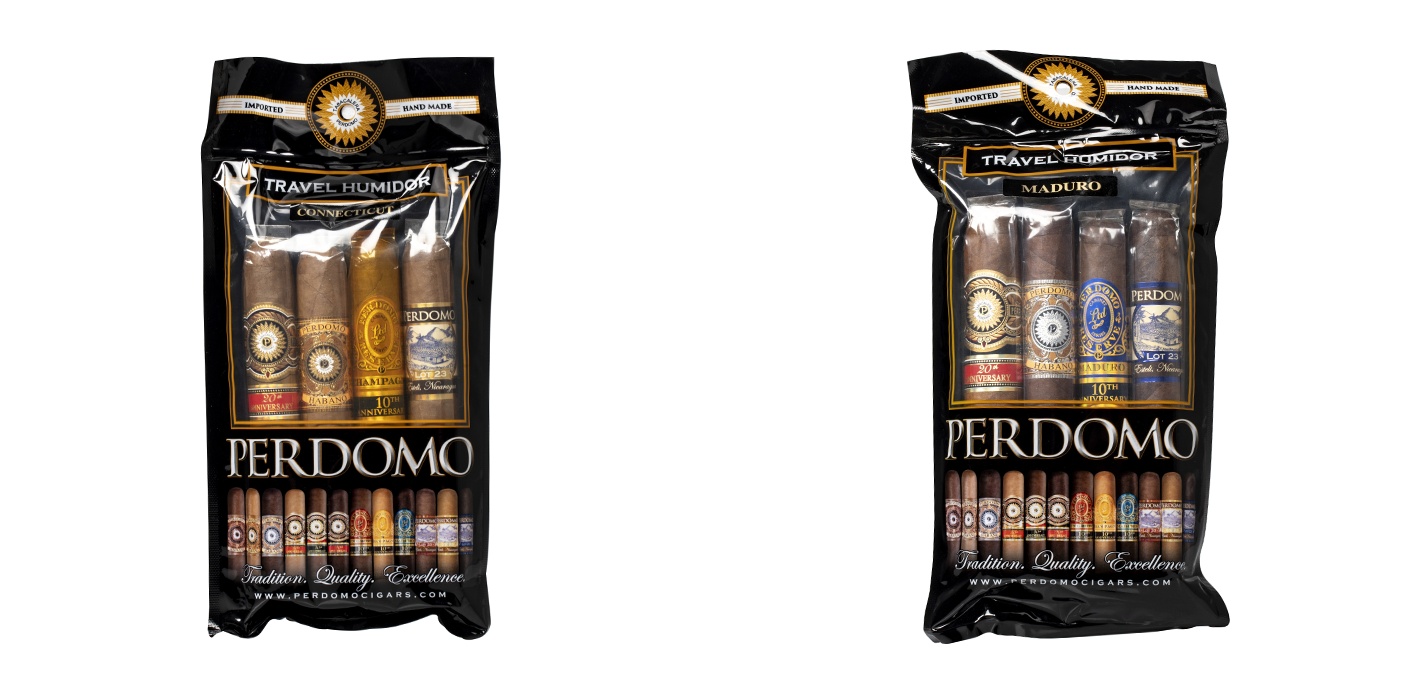
The Legacy line isn't the only iconic Perdomo blend worth knowing. Among the brand's wide range of products, the sampler packs stand out, and I personally love them because they offer a little taste of everything Perdomo makes. Digging into a few of these samplers is one of the best ways to understand the brand holistically.
This sampler pairs different Connecticut wrappers with Nicaraguan binder and filler. It includes:
These cigars land in the mild-to-medium range, with a creaminess that comes through in each one. I like this sampler in particular because it offers a flexibility and versatility you don't get from a standard box.
Since these are on the milder side, pairing the Perdomo Connecticut 4-Cigar Sampler with a glass of light champagne is always a good move. This particular lineup is very airy and could use a beverage that complements its mellow, earthy taste. As for non-alcoholic drinks, a honeyed tea would pair deliciously.
In addition to the Connecticut Sampler, the Perdomo Maduro 4-Cigar Sampler is another offering that provides a taste from the different collections.
This sampler showcases barrel-aged leaf accompanied by Nicaraguan long fillers. Featured in the Maduro Sampler is:
Unlike the Connecticut Sampler, coffee and spice tasting notes are the hallmarks of these cigars. They run medium to full in intensity, so a heavier drink is welcome alongside them. A nice bourbon or whiskey blend is a typical pairing. But if you really want to go outside the box, try Mexican hot chocolate with cayenne pepper. It's a subtle spice that really enhances the deep flavor waiting to be unlocked.
The Maduros in this package are each completely unique and indicative of Perdomo's craftsmanship. If you're new to cigars, this sampler pack is a great one to start with. It features the headiness you'll find in some of the more matured cigars, and it'll give you a sense of what your palate should expect from a heavier smoke.
We would be remiss if we didn't at least mention the Champagne line, because this is probably Perdomo's most popular item. It first debuted in 2002, celebrating the company's 10-year anniversary. Made with a butterscotch-golden Ecuador Connecticut leaf wrapped tightly around Nicaraguan fillers, it's a medium-bodied smoke that's extremely approachable, with notes of earth, graham cracker, and a touch of spicy pepper rounding it out. It's a buttery cigar that practically melts in your mouth.
Since it has such an amenable taste, this cigar pairs well with a variety of things: spiked lemonade punch, scotch, or my personal favorite, black coffee. All of these are strong and edgy enough to accentuate and cut through some of that creaminess.
Coined "El Monstro" by locals in the Estelí, Nicaragua region, the Perdomo factory is said to be the second-largest in the area. With a fully vertical production process, the Perdomo family oversees everything from seed growth and leaf cultivation all the way to packaging.
One of the newer things the Perdomo family has done is launch a podcast covering tobacco, the aging process, and everything cigar related. It's a good example of the brand stepping outside the traditional cigar company playbook and into new media. Nick Perdomo III co-hosts alongside his father, Nick Perdomo Jr., so even the podcast has that family thread running through it. Speaking of family, Nick Jr.'s wife, Janine Perdomo, serves as the company's Chief Operating Officer. It'll be worth watching how the family grows "El Monstro" from here, and whether more hybridized seeds like the one behind the Legacy line end up on the market.
Perdomo's legacy has inspired cigar makers across the globe. The company also backs the future of the industry through its multi-day factory tours in Estelí, sometimes called a "cigar academy," where retailers and enthusiasts alike can learn the craft from seed to shelf.
The Perdomo legacy isn't just a name on a cigar band, instead it's a family tree you can taste.
Silvio Perdomo never got to see what his grandson would build. He left Havana with nothing but the knowledge in his hands and the stubbornness to keep going. Nick Jr. took that inheritance and turned it into something neither of them could have imagined from a garage in Miami.
Three generations later, the family still runs every step of the operation themselves. That's rare in this industry. Most brands outsource. Most brands cut corners where nobody's looking. Perdomo doesn't, and it’s evident in every cigar they make.
0 Comment
Latest