WARNING: This product contains nicotine. Nicotine is an addictive chemical.


NEWSLETTER
Get special offers and find out what's new in the store. Sign up for the EV newsletter.WARNING: This product contains nicotine. Nicotine is an addictive chemical.
NEWSLETTER
Get special offers and find out what's new in the store. Sign up for the EV newsletter.Ask ten different cigar smokers to name the brand that introduced them to Nicaraguan tobacco, and there’s a good chance at least a few of them will say Oliva. It’s one of those names that keep coming up. At cigar lounges, in online forums, on “best of the year” lists, not because of clever marketing, but because the cigars simply deliver box after box, year after year.
We put this guide together for two kinds of people: the curious newcomer standing in front of a wall of options wondering where to even begin, and the longtime fan who wants a refresher on what makes each line in the Oliva family tick. Either way, by the end of this you’ll know exactly what to reach for next.
Oliva’s story doesn’t start in a boardroom, it starts in a tobacco field. Back in 1886, Melanio Oliva began growing premium tobacco in Cuba’s famed Pinar del Rio region. For decades, the Oliva family built their reputation on that Cuban soil, passing the craft down from generation to generation.
Then history intervened. As political instability grew in Cuba, the family was forced to leave everything behind and start over. Gilberto Oliva searched far and wide, the Philippines, Mexico, Panama, Honduras, looking for land that could recreate the character of the tobacco his family had grown for generations. He eventually found it in Nicaragua, whose rich volcanic coil and climate turned out to be a perfect match.
That resilience is really the heart of the Oliva story. Today, the family’s cigars are handcrafted in Esteli, Nicaragua, and the brand has become one of the most decorated names in the industry, regularly landing on “Top Cigars of the Year” lists.
A lot of that resilience shows up in how particular the family is about their leaf. When the Olivas resettled in Nicaragua, they weren’t just looking for “good enough” farmland. They were chasing the same growing conditions that had made their Cuban tobacco so prized in the first place. Esteli’s volcanic soil, humidity, and sun exposure turned out to be a near-perfect match, which is a big part of why Nicaraguan tobacco in general, and Oliva’s in particular, has such a devoted following.
The family also isn’t shy about experimenting with wrapper leaf. Depending on the line, you’ll find Ecuadorian Connecticut, Ecuadorian Habano, Mexican San Andres, Connecticut Broadleaf, and even African Cameroon wrappers in the Oliva portfolio. Each one changes the personality of the cigar significantly, which is part of why the brand has so many distinct series instead of just one flagship blend.
Nearly every Oliva cigar is hand-rolled at the family’s own factory, Tabacalera Oliva (TABOLISA), in Esteli. That in-house control matters, it means the same family that grows and ferments the tobacco is also the one rolling it, so there’s no gap between the field and the finished cigar. That vertical integration delivers Oliva cigars that possess a reputation for consistency: a Serie V you pick up today should smoke remarkably similar to one from a box a year ago, which is no small feat in an industry where crop variation can throw off a blend from harvest to harvest.
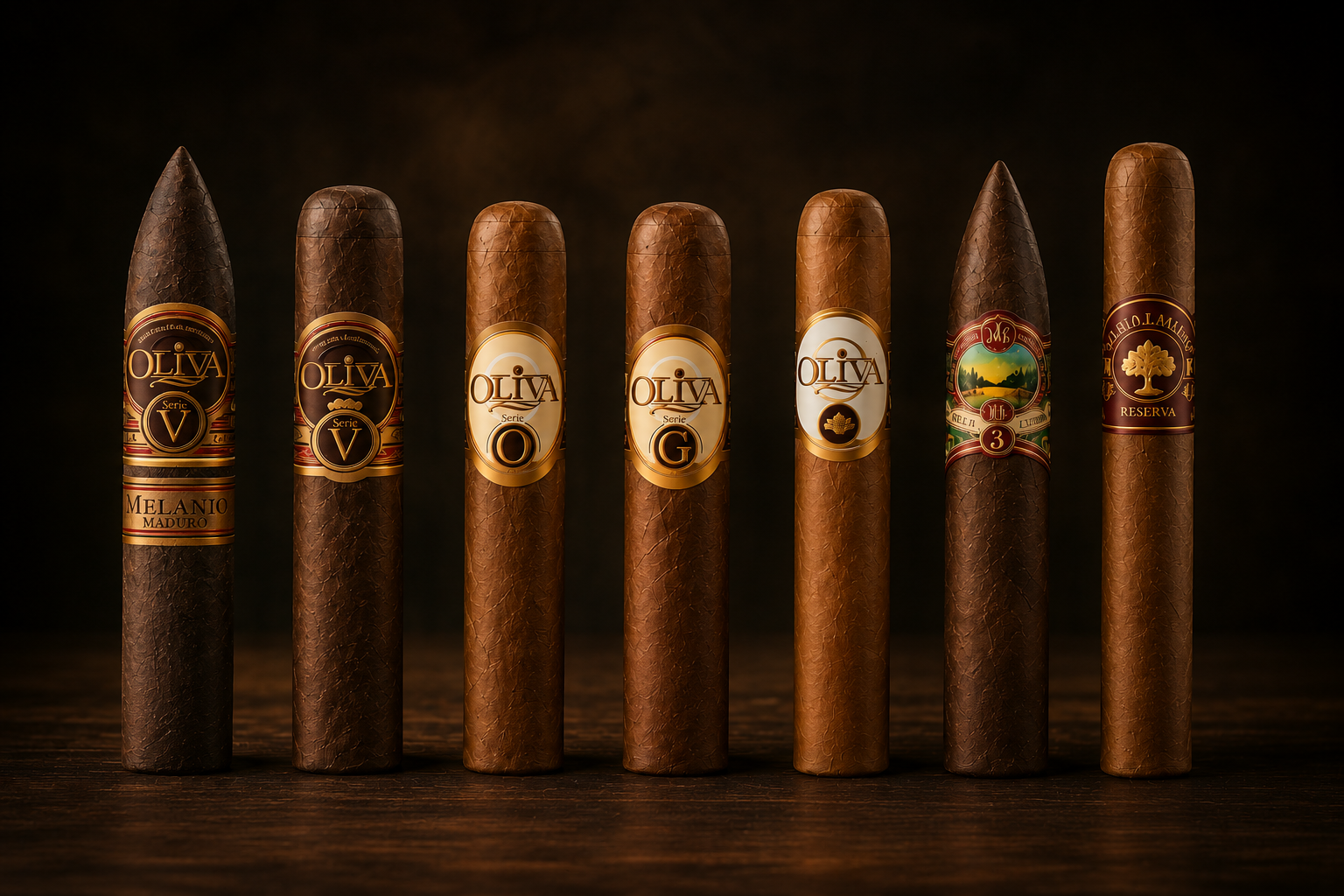
Oliva’s lineup is deep, and each series has its own personality. Here’s a rundown of the ones worth knowing.
This is the cigar that really put Oliva on the map. A Nicaraguan puro, meaning every component, from filler to binder to wrapper, is grown in Nicaragua, the Serie V is bold, rich, and satisfying. It’s built around specially fermented ligero from Jalapa Valley, which gives it that signature depth and intensity. Since its debut, it’s landed on numerous “Top 25 Cigars of the Year” lists, and it remains a benchmark for what a full-flavored Nicaraguan cigar should taste like.
Named in tribute to family patriarch Melanio Oliva, this is widely considered the crown jewel of the collection. It takes the bold Nicaraguan core of the Serie V and wraps it in a delicate Ecuadorian Connecticut leaf (or a Mexican San Andres wrapper for the Maduro version), adding layers of sweetness and complexity to the power underneath. It was named Cigar of the Year in 2014 and it’s still a go-to recommendation for anyone who wants to understand what Oliva is capable of at its best.
If you like your cigars rich, dark, and a little spicy, the Serie G is worth a look. It leans on Nicaraguan Sun Grown ligero fillers under a rich African Cameroon wrapper, delivering notes of cedar and coffee. It’s a slow-sipping cigar, the kind you pour a drink for and settle in with.
A more approachable, medium-bodied option that still delivers plenty of character. It’s a great entry point if you’re newer to Nicaraguan tobacco and want something flavorful without being overwhelming.
For smokers who love flavor but prefer a gentler ride, Connecticut Reserve is the pick. It pairs Nicaraguan long-fillers with a smooth, silky Ecuadorian Connecticut Shade wrapper, resulting in a mild-to-medium smoke that’s creamy and easygoing. Perfect for a morning coffee or a relaxed afternoon.
This one has serious pedigree. It’s the last surviving release from Oliva’s original Master Blend Series (which debuted in 2003), and it’s still in continuous production today thanks to its devoted fan base. Box-pressed and wrapped in Nicaraguan sun-grown Broadleaf, its delivers rich, traditional Nicaraguan character in every draw.
Released in 2017 in honor of family patriarch Gilberto Oliva, this line uses fermented ligero fillers and binders for a robust, medium to full-bodied smoking experience that pays homage to the family’s roots.
With this many lines, choosing can feel overwhelming, so here’s a simple way to think about it:
The Connecticut Reserve or Serie O are usually the friendliest starting points. Both are flavorful without the intensity that can catch newer smokers off guard.
The Serie V Melanio is generally considered the standout, having earned Cigar of the Year honors and consistently high rating major cigar publications.
Yes, nearly the entire lineup is hand-rolled at the family’s own factory in Esteli, Nicaragua, which is a big part of why the quality stays consistent across releases.
Like any premium cigar, they’ll stay in top form in a properly humidified humidor, ideally kept around 65-70% relative humidity and a stable temperature.
What sets Oliva apart isn’t just the tobacco, it’s the story behind it. Four generations of a single family, pushed out of their homeland and rebuilding from scratch, ended up creating some of the most award-winning cigars in the modern era. Every Oliva you smoke carries a little bit of that history with it.
Ready to find your favorite? Browse our full selection of Oliva and find the blend that’s right for you.
0 Comment
Sam is a music lover, snack enthusiast, and self-appointed arugula ambassador who somehow turned all of that into a whole career in writing. Fueled by all the comforts in life and an inexplicable obsession with the spiciest leaf in the salad game, she brings the same chaotic passion to every article that she brings to her own life.
Latest