WARNING: This product contains nicotine. Nicotine is an addictive chemical.


NEWSLETTER
Get special offers and find out what's new in the store. Sign up for the EV newsletter.WARNING: This product contains nicotine. Nicotine is an addictive chemical.
NEWSLETTER
Get special offers and find out what's new in the store. Sign up for the EV newsletter.Every so often, a cigar brand comes along at exactly the right moment and ends up defining an era. La Gloria Cubana is one of those brands. Born in Havana in the 1800s, reborn in Miami’s Little Havana, and catapulted to stardom during the 1990s cigar boom, it earned a reputation as one of the first true “boutique” cigars, back when that word barely existed. It also helped kick off the big ring gauge craze that’s still going strong today, so if you’ve ever reached for a fat 60-ring cigar, you can thank La Gloria Cubana for helping make that the norm.
This guide covers the brand’s journey from Cuba to Miami to the modern General Cigar portfolio, what makes it distinct, and which lines are worth lighting up.

La Gloria Cubana’s story starts in Cuba in 1885, when the brand was created in Havana by the Sociedad Cabañas y Castro. That was the golden age of Havana cigar making, when dozens of marques competed for the attention of smokers across Europe and the Americas, and La Gloria Cubana quickly became one of the names worth knowing. The brand changed hands a few times over the following decades. In the early 1900s it was acquired by a Havana cigar maker named José F. Rocha, and after Rocha died in 1954, the Cifuente s family, the same family behind Partagás, bought La Gloria Cubana along with the Bolívar brand.
Then history intervened. The 1959 Revolution disrupted Cuba’s private cigar industry, and production of La Gloria Cubana ground to a halt for years. The brand saw a brief, limited resurgence in the mid-1960s, but by then many of the great Cuban cigar families, including the Perez-Carrillos, had already left the island and were rebuilding their lives, and their craft, in exile. Eventually, the Cifuentes family sold the La Gloria Cubana name rights to the Perez-Carrillo family, and that handoff is where the brand’s second life began.
The new home for La Gloria Cubana was El Crédito, the Perez-Carrillo family’s cigar factory in Miami’s Little Havana neighborhood. If you know anything about Little Havana, you know it became the beating heart of Cuban-American culture, a place where exiled rollers, blenders and tobacco people carried their traditions forward in small shops and factories. La Gloria Cubana was made there in small batches for a loyal local audience, the kind of cigar you picked up because the people who made it were your neighbors.
The modern blend really took shape in 1982. As the story goes, Ernesto Perez-Carrillo smoked a Cuban Davidoff and was struck by how elegant and balanced it was. He set out to create something with the same refinement, which he described as “a total sensuous smoke.” When he finally landed on a blend he loves, he put the La Gloria Cubana name on it, and Miami smokers embraced it the same way Havana smokers had embraced the original generations earlier.
Then came the 1990s. As the American cigar boom took off and Cigar Aficionado began publishing ratings in the early part of the decade, La Gloria Cubana earned high marks and shot to national attention. Many critics and smokers considered it the first true “boutique” cigar, a small-batch brand with big-company flavor and a personal story behind it. Demand exploded, and it grew so fast that the family had to open a second factory in the Dominican Republic just to keep up. For a brand that had spent years as a neighborhood favorite, it was a dramatic rise.
In 1999, Swedish Match, the parent company of General Cigar, purchased El Crédito from the Perez-Carrillo family. The deal brought La Gloria Cubana into a stable that already included Macanudo and the non-Cuban editions of brands like Cohibe, Punch, and Partagás. Ernesto stayed on for roughly a decade, continuing to shape the brand and experiment with larger ring gauges and bolder blends, before leaving in 2009 to launch his own company, E.P. Carrillo (we’ve got a full guide on that one too).
As the years went on, La Gloria Cubana kept evolving to match what smokers wanted. When demand grew for bigger, bolder cigars, the brand answered with the Serie R, marketed as “the ultimate in bold flavor.” The Serie R Black and Serie N followed, extending the same big-personality approach. In 2013, the brand made a notable move to Nicaragua with the Serie R Estelí, its first puro, which went on to earn a spot on Cigar Aficionado’s Top 25 list the following year. More recent additions include Spanish Press (2019) and Colección Reserva.
Today, the brand’s blending and production are overseen by Yuri Guillen, and the cigars are made largely in General Cigar’s factories in the Dominican Republic and Nicaragua. It’s an interesting spot for a brand to be in: it operates inside one of the biggest cigar companies in the world, but it has held onto the boutique identity it earned back in Little Havana.
One quick but important note: there are actually two La Gloria Cubana brands. The original Cuban La Gloria Cubana, still made in Havana, isn’t legally sold in the United States because of the embargo. The one you’ll find at Element Vape is the non-Cuban brand with the Miami heritage.
Boutique roots, big-company consistency. The brand grew out of a small Miami operation, yet today it benefits from the resources and quality control of the industry’s larger manufacturers.
A pioneer of big ring gauges. La Gloria Cubana was at the forefront of the shift toward thicker cigars, and the Serie R remains one of the most recognizable big-ring-lines on the market.
Bold but balanced. The brand is known for full flavor without feeling wild or out of control, a balance that keeps people coming back.
Real range in the lineup. With natural and maduro wrappers, Dominican blends, and Nicaraguan puros, there’s a La Gloria Cubanan for several different palates.
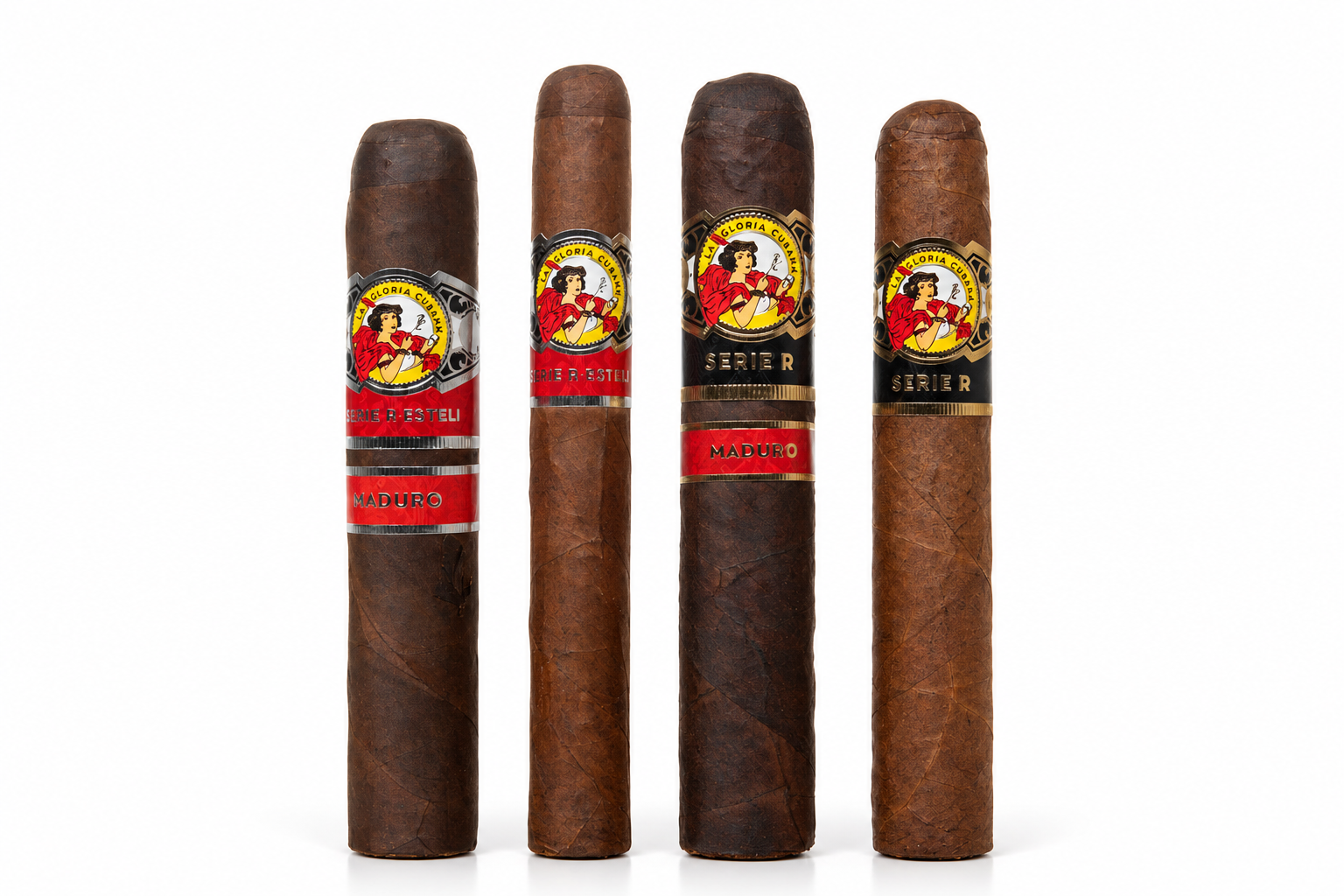
The brand’s flagship and its first major line extension, Serie R was marketed as “the ultimate in bold flavor,” and it’s the cigar that defines the modern La Gloria Cubana for many smokers. The Natural version pairs an Ecuadorian Sumatra wrapper with a blend of Dominican and Nicaraguan long-fillers, and the Dominican filler is aged several years longer than the tobacco in the brand’s original blend, which helps smooth out the intensity. The result is a full-bodied, rich, robust smoke that still manages to feel balanced rather than harsh. The line is famous for its big-ring shapes, including the legendary 5 ⅞ x 60 No. 6, a chunky gordo that smokes slowly and rewards with a long, flavorful session.
This is the same big-ring approach as the original Serie R, but wrapped in an oily Connecticut Broadleaf Maduro leaf. Broadleaf wrappers are known for bringing a natural, dark sweetness to a blend, so expect a smoother, slightly richer and more indulgent take on the Serie R profile, with the full body you’d expect from the line. It’s a great pick for smokers who love the dark, sweet character of a good maduro, and it pairs beautifully with an after-dinner drink.
Launched in 2013, this was the brand’s first move into Nicaraguan puro territory, a large-ring, full-flavored cigar built entirely from Nicaraguan tobacco. Estelí is one of Nicaragua’s most celebrated growing regions , known for producing bold, spicy tobacco, and the Serie R Estelí leans into that character. It earned a 91-point rating and a spot on Cigar Aficionado’s Top 25 list in 2014, and it remains one of the most respected releases in the La Gloria Cubana portfolio, especially for smokers who already love Nicaraguan blends.
A maduro-wrapped follow-up to the Estelí, this release keeps the Nicaraguan backbone but adds an extra layer of dark sweetness from the wrapper. It’s a good choice if you enjoy the spice and body of a Nicaraguan puro but want it softened and rounded out a bit by the richness of a maduro leaf.
These later additions extend the brand’s big, bold personality, giving fans more ways to explore the Serie family beyond the original Natural and Maduro. If you’ve already worked your way through the core Serie R lineup and are looking for something that scratches the same itch with a slightly different twist, these are the lines to look at next.
One of the brand’s more recent additions (2019), Spanish Press reflects how La Gloria Cubana has kept evolving over the years. It carries the same balanced, flavor-driven approach that defines the brand’s best lines, offering a more modern take on the La Gloria style while staying true to the brand’s reputation for bold flavor that doesn’t get out of control.
A more premium-minded line with the portfolio, Colección Reserva is aimed at smokers who want a little extra refinement alongside the brand’s signature flavor. It’s a nice option for a special occasion or for anyone who wants to see what La Gloria Cubana can do when the focus shifts from sheer size to nuance.
Start with the Serie R if you want the classic experience. It’s the line that defines the modern La Gloria Cubana.
Choose the Maduro if you like a sweeter, darker smoke. Same big personality, different flavor direction.
Go for the Serie R Estelí if you’re a fan of Nicaraguan puros. It’s one of the most acclaimed releases in the portfolio.
Mind the ring gauge. Many of these cigars are big and take a while to smoke, so set aside some time and pour yourself something good.
Not the one sold in the US. The original La Gloria Cubana was created in Havana in 1885, but the version available at American retailers is a non-Cuban brand with roots in Miami, made today by General Cigar Company.
The original brand dates back to Havana in the 1800s. The modern, non-Cuban version was developed by Ernesto Perez-Carrillo, who launched it in Miami and built it into a star of the 1900s cigar boom before selling it to General Cigar in 1999.
The Serie R is widely considered the brand’s flagship, known for its big ring gauges and full-bodied flavor.
Generally it’s better for smokers who already enjoy full-bodied cigars, though the balance of flavor makes it more approachable than its bold reputation suggests.
La Gloria Cubana has been through a lot: a Havana beginning, a Miami revival, a boom-era breakout, and a new life inside a major cigar company, Through all of it, the brand has held onto what made people love it in the first place, which is bold, balanced flavor in big, satisfying package.
If you’re new to the brand, start with a Serie R and see how you like it, then branch out to the Maduro or the Estelí. Chances are you’ll understand pretty quickly why this one has stuck around for decades.
Ready to start your La Gloria Cubana Cigar journey?
Check out our collection at Element Vape.
0 Comment
Sam is a music lover, snack enthusiast, and self-appointed arugula ambassador who somehow turned all of that into a whole career in writing. Fueled by all the comforts in life and an inexplicable obsession with the spiciest leaf in the salad game, she brings the same chaotic passion to every article that she brings to her own life.
Latest