WARNING: This product contains nicotine. Nicotine is an addictive chemical.


NEWSLETTER
Get special offers and find out what's new in the store. Sign up for the EV newsletter.WARNING: This product contains nicotine. Nicotine is an addictive chemical.
NEWSLETTER
Get special offers and find out what's new in the store. Sign up for the EV newsletter.If there’s one name in the cigar world that even non-smokers seem to recognize, it’s Cohiba. It’s the brand that shows up in movies as shorthand for luxury, the one collectors talk about in hushed, reverent tones, and the one that carries a mystique few other cigars can match. Part of that reputation comes from excellent tobacco. Part of it comes from decades of careful brand-building that turned Cohiba into shorthand for “the good stuff.”
As with a few other legendary cigar names, Cohiba exists today as two separate brands: the original Cuban Cohiba, produced under Habanos S.A. and unavailable in the United States, and the non-Cuban Cohiba, produced primarily in the Dominican Republic by General Cigar Company and widely available at US retailers. This guide will walk you through the fascinating history behind the name, the difference between the two versions, and which non-Cuban Cohiba lines are worth adding to your humidor.

Cohiba’s story starts in an unusual place: not a factory, but a personal favor. In the mid-1960s, a bodyguard close to Fidel Castro was smoking a hand-rolled cigar made by a friend using tobacco grown near Havana. Castro reportedly tried, loved it, and had a small production operation set up specifically to create cigars for himself and other high-ranking Cuban officials. For years, Cohiba wasn’t sold commercially at all, it existed purely as a private, government-controlled cigar reserved for diplomatic gifts and internal use.
That changed in 1982, when Cuba began releasing Cohiba commercially, largely as a way to compete in the international luxury cigar market. Given its origins as literally “Castro’s cigar,” Cohiba launched with an air of exclusivity that few other brands could claim, and it quickly became regarded as one of the finest, most prestigious to come out of Cuba.
Because of the ongoing US embargo on Cuban goods, the Cuban Cohiba has never been legally available in the United States. That created an opening, and in the 1990s, General Cigar Company, which already registered the Cohiba trademark in the US years earlier, released its own non-Cuban Cohiba, made with tobacco sourced from the Dominican Republic. This set off a long-running trademark dispute between General Cigar and Cubatabaco (the Cuban government’s cigar arm) that played out in US courts for years, with General Cigar ultimately retaining the rights to sell Cohiba cigars in the United States.
Cuban Cohiba is produced by Habanos S.A. using 100% Cuban tobacco. It remains one of the most prestigious and expensive cigars in the world, prized by collectors and enthusiasts outside the US. Due to the trade embargo, it cannot be legally purchased in the United States.
Non-Cuban Cohiba, the version sold at Element Vape and other US retailers, is produced by General Cigar Company primarily in the Dominican Republic, using tobacco from the Dominican Republic, Nicaragua, and occasionally other growing regions. While it’s a different blend from its Cuban counterparts, the non-Cuban Cohiba has built a serious reputation of its own, earning strong reviews and a loyal following among American cigar smokers who want that Cohiba name and quality without need to travel outside the US to find it.
It’s worth noting that neither version should be thought of as an imitation of the other at this point. They’re two distinct product lines, made by two different companies, that happen to share a name and a common origin story.
A genuinely compelling origin story. Few cigars can claim a backstory tied directly to a world leader’s personal preferences, and that history has become deeply embedded in the brand’s identity and appeal.
Consistent quality across the non-Cuban lineup. General Cigar has invested heavily making sure the American Cohiba lives to the name, and the brand routinely earns strong marks from cigar critics.
A sense of occasion. Because of its prestige and history, Cohiba is often the cigar people reach for to mark something significant. A promotion, an anniversary, a celebration. It carries a weight that a lot of everyday cigars simply don’t.
Range across the portfolio. While Cohiba built its name on rich, luxurious blends, the non-Cuban lineup spans a decent range of body and intensity, meaning there’s more than one entry point depending on your preference.
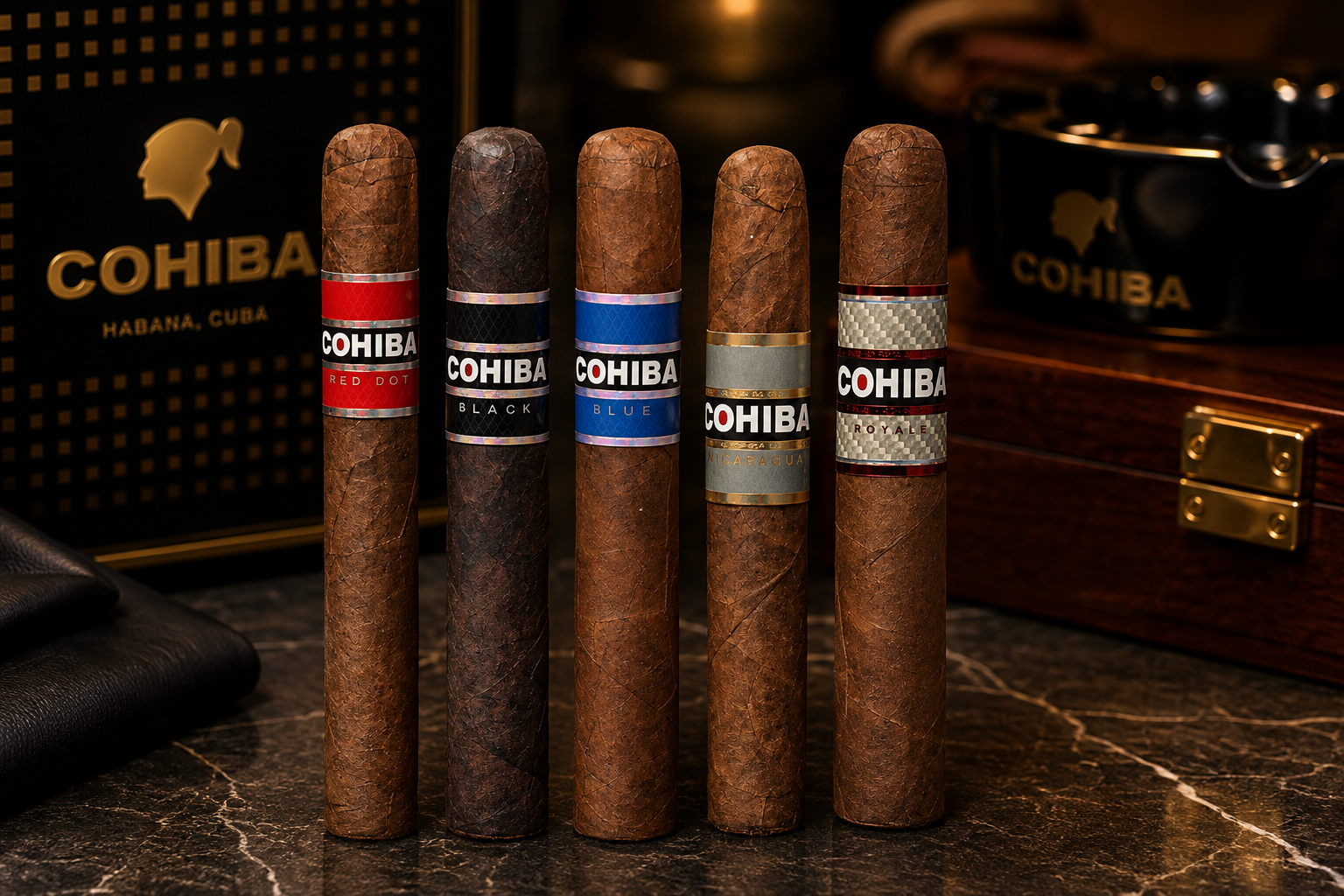
Often referred to as the “Red Dot” because of its distinctive red band, this is the original non-Cuban Cohiba release and remains the brand’s flagship. It uses a Dominican-grown, Cameroon-seed wrapper and delivers a smooth, medium-bodied smoke with notes of cedar, leather, coffee, and subtle spice. It’s the cigar most associated with the American Cohiba name.
A bolder departure from the Classic, Cohiba Black uses a dark Connecticut Broadleaf Maduro wrapper and delivers a fuller-bodied, spicier smoking experience with notes of espresso, cocoa, and paper. It’s a favorite among smokers who want the Cohiba name attached to something with real intensity.
Positioned as the mildest option the modern Cohiba lineup, Cohiba Blue uses and Honduran wrapper and offers a smooth, creamy profile that’s more approachable for newer smokers or anyone who prefers a gentler smoke without sacrificing the brand’s reputation for quality.
As the name suggests, the line shifts to an all-Nicaraguan tobacco blend, delivering a rich, medium-to-full-bodied smoke with notable spice and earthiness. It’s a great option for smokers who already gravitate toward bold Nicaraguan puros and want to see Cohiba’s take on that style.
A more limited, upscale release within the lineup, Cohiba Royale is built around a Nicaraguan broadleaf wrapper and offers a smooth, full-bodied profile with notes of cedar, dried fruit, and a black pepper finish.
Start with the Red Dot if you want the “classic” experience. It’s the most historically significant of the non-Cuban releases and a great baseline for understanding what the American Cohiba is all about.
Go with Cohiba Blue if you’re newer to cigars. It’s the mildest option and won’t overwhelm an underdeveloped palate.
Choose Cohiba Black or Nicaragua if you already like bold, full-bodied cigars. These lines lean hard into spice and richness.
No. Due to the ongoing US trade embargo on Cuba, Cuban-made Cohiba cigars cannot be legally sold in the United States. The Cohiba cigars available at US retailers are the non-Cuban version, produced by General Cigar Company primarily in the Dominican Republic.
The split dates back to a long-running trademark dispute between General Cigar Company, which held US rights to the Cohiba name, and Cubatabaco, the Cuban government’s cigar company. Both versions continue to be produced today, each under its respective company.
It depends on the line. Cohiba Blue is a solid choice for newer smokers thanks to its mild, approachable profile, while lines like Cohiba Black, Nicaragua, and Royale are better suited to more experienced smokers who already enjoy full-bodied cigars.
Few cigars carry the weight of history and prestige that Cohiba does, and that reputation has been earned through both a genuinely fascinated origin story and decades of consistent, high-quality production. The non-Cuban Cohiba lineup available in the US has built its own strong identity, offering a real range of options from the smooth, approachable Blue to the bold, intense Royale.
If you’re picking up your first Cohiba, start with the Red Dot to experience the classic profile the brand built its reputation on, then branch out based on how bold you like your cigars from there. Given the name attached to it, there’s a good chance your first Cohiba will feel like more than just another smoke, it comes with a story worth knowing.
Ready to start your journey with Cohiba Cigars?
Check out Element Vape's full Cohiba Collection!
0 Comment
Sam is a music lover, snack enthusiast, and self-appointed arugula ambassador who somehow turned all of that into a whole career in writing. Fueled by all the comforts in life and an inexplicable obsession with the spiciest leaf in the salad game, she brings the same chaotic passion to every article that she brings to her own life.
Latest