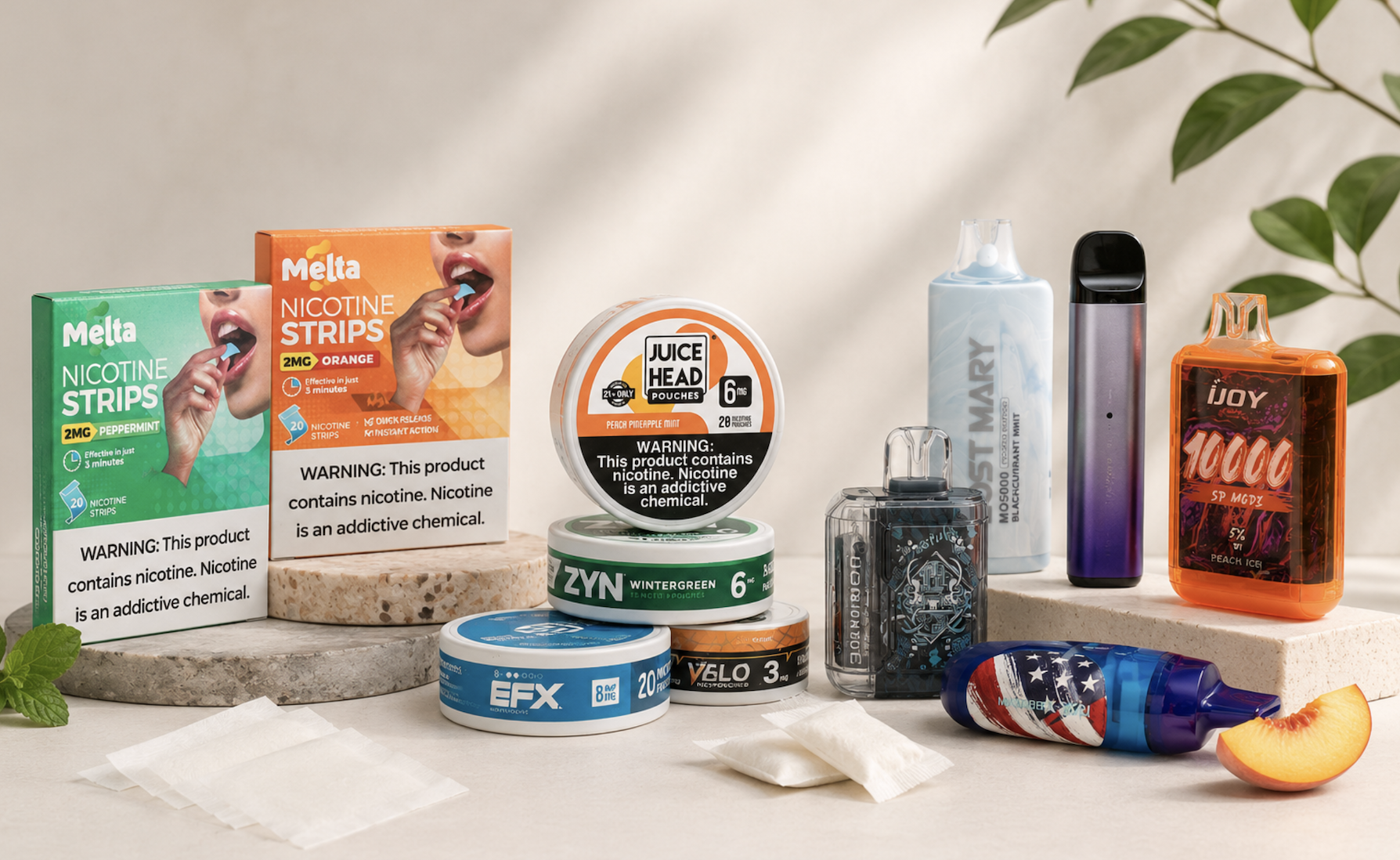
WARNING: This product contains nicotine. Nicotine is an addictive chemical.
WARNING: This product contains nicotine. Nicotine is an addictive chemical.
NEWSLETTER
Get special offers and find out what's new in the store. Sign up for the EV newsletter.Posted: August 23, 2026

If you need a nicotine fix, you've got more options than ever, and more ways to waste money on the wrong one. Pouches, vapes, and strips each hit differently, and knowing which one fits your life is the difference between a product that works and one that collects dust in your bag.
So let's break down exactly how each one gets nicotine into your system, how fast, what the strength labels actually mean, and who each one is really made for.
All three methods deliver nicotine into your bloodstream, but they take very different routes which changes everything about the experience.
Pouches and strips both absorb through the mucous membranes in your mouth. With a pouch, you tuck it between your gum and lip and let it do its thing. Nicotine starts entering your bloodstream within 2 to 5 minutes and builds gradually from there. Strips work the same way but faster: place one on your tongue, it dissolves almost instantly, and active absorption kicks in around the 3-minute mark. Both are completely smokeless and discreet.
Vaping works a little differently as nicotine is primarily absorbed through your lungs, which actually makes the process less direct. Peak absorption takes longer, hitting somewhere between 5 and 10 minutes after your first puff. You also have less control over exactly how much you're taking in per session, since vaping is continuous rather than dose-fixed.
That consistency is one of the strongest arguments for pouches and strips. The guesswork that comes with vapes is one of the biggest turn offs for users. However, before getting to actually using these products you have to know dosages which start with knowledge on milligrams.
Here's where things get confusing, because each method measures nicotine completely differently.
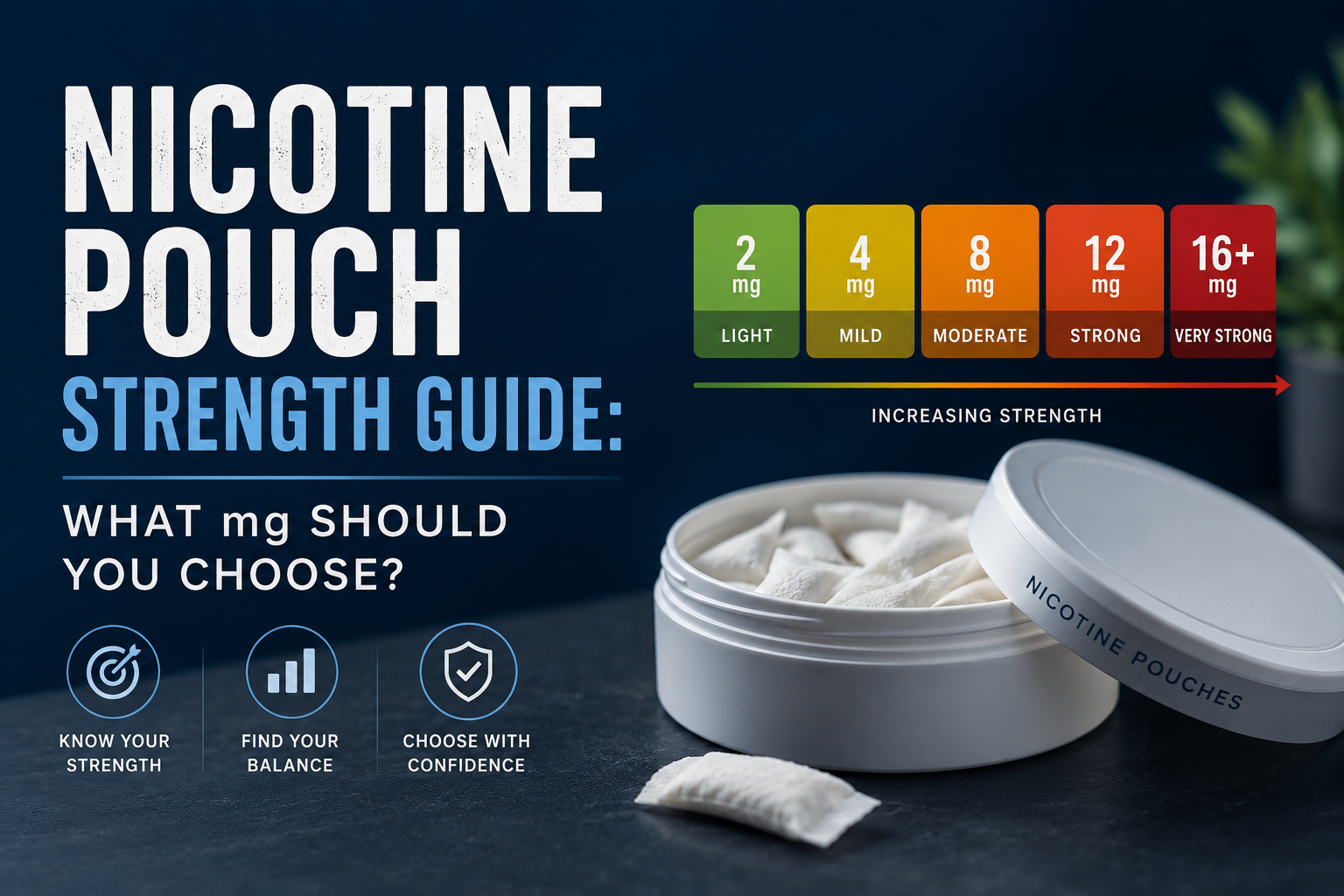
Pouches are measured in milligrams per pouch. Beginners typically start in the 3–4mg range, while more experienced users land somewhere between 6 and 16mg. Some brands push even higher for heavy users. It's one of the more intuitive systems as the number on the can is exactly what you're getting.
Strips are also measured in milligrams, with 2mg and 6mg being the most common options. The range is narrower than pouches, but that's by design. Strips are built for situations where you want something quick, clean, and invisible; you put it on your tongue and it's gone in seconds.
Vaping is where label reading gets more nuanced. Disposable vapes typically list a nicotine percentage, and 5% is the standard. But if you're buying bottled e-liquid, the format depends on the type you're using. Nicotine salts usually come in 30mL bottles at strengths like 20mg, 35mg, or 55mg. Freebase nicotine comes in larger 100mL bottles at lower concentrations like 0mg, 3mg, or 6mg. The difference between the two matters as salts are smoother at high strengths and easier to inhale, while freebase at higher concentrations can feel genuinely harsh. So bottle size isn't just packaging, instead it acts as a signal about what kind of experience you're walking into.
A 6mg e-liquid and a 6mg pouch share the same number on the label, but they hit completely differently.
Vaping delivers the most immediate feedback of the three. You feel it in your throat and chest within seconds, and how you inhale affects your experience. A direct-to-lung (DTL) hit sends vapor straight down and feels more intense; mouth-to-lung (MTL) is a slower draw where you hold the vapor in your mouth before inhaling, a little gentler for beginners. Either way, the buzz is puff-dependent, meaning you have to keep going back to maintain it. The trap is going too hard too fast because when you stack loads of puffs in a short window your buzz tips over into nausea.
That being said, pouches are a completely different ride, because nicotine absorbs slowly through your gum, onset is gradual with lower intensity, but lasts longer. It builds quietly and sits with you instead of spiking and fading.
New users (or anyone jumping to a higher strength) might experience "niccups,” nicotine hiccups caused by your nervous system reacting to the hit. They're harmless and common, so if it happens, just remove the pouch and take a minute.
Strips land somewhere between the two. They dissolve nearly instantaneously and absorb fast, so you'll feel a clean, noticeable boost within minutes. Not the slow build of a pouch or the throat hit of a vape, instead it elicits more of an efficient, direct kick.
Vaping is not a discreet activity, which is why some people try "stealth vaping." This is where users exhale a held-in hit, but it's not reliable, and vapor in a no-smoking zone is still vapor.
Pouches and strips, on the other hand, are essentially invisible. Nothing to exhale, nothing to see. A moist pouch might cause some extra saliva, but nobody is going to notice.
What pouches and strips don't offer is the hand-to-mouth ritual, and for a lot of people that ritual is the whole appeal of vaping. It's social, it's tactile, and it gives you something to do with your hands, making every session a shared experience.
Heavy vapers often report 200 to 500+ puffs per day. Pouch users typically go through 8 to 10 pouches. Strip usage data is still limited since they're relatively new to market. Which exemplifies their popularity and highlights the importance of being able to differentiate between them in this growing market.
Vaping has the widest range of prices, and at the simple end, disposables run $10–$25 each, but the ongoing replacement cost adds up. Pod systems range from $15–$50 for the device, plus $5–$11 per pod and $10–$14 for e-liquid.
If you go deep into rebuildable setups (RDAs, RTAs, custom mods), you're looking at $30–$70 for the build hardware alone, plus coils, wire, and wicking material. The investment scales with how serious you get.
However, when it comes to pouches, the pricing is more straightforward with tins retailing around $3–$7, with 15 to 20 pouches included. It's one of the more cost-predictable options in this category.
Strips are in a similar range at $4–$10 per pack, depending on brand and quantity.
If cost consistency matters to you, pouches and strips are easier to budget. Vaping costs depend heavily on your setup and how invested in the culture you are.
Vapes are the kings of flavor selection with a wide range of custom blends and profiles like fruit, menthol, dessert, beverage, and tobacco. If flavor variety is a big part of what you enjoy about nicotine, vaping is hard to compete with.
Nicotine pouches offer solid variety across mint, menthol, tobacco, fruit, and some coffee or citrus options, but the selection is more limited. Strips are newer to market and currently have the narrowest range of the three offering mostly mint and menthol, with some fruit options depending on brand.
If you're someone who gets bored easily or loves chasing new flavors, pouches and strips may feel restrictive over time.
If you enjoy rituals, consider yourself a flavor enthusiast, and appreciate nicotine for its social aspect, then vaping is a natural choice, whether you're hanging out with friends or in any situation where having something in your hand is part of the experience.
However, if discretion and a nice, steady release of nicotine are more your vibe, then a precisely dosed nicotine pouch can be your sidekick nearly anywhere without bothering anyone around you.
But if you’re in a rush and just want the fastest delivery of nicotine in the most minimal format then a strip is perfect. They're ideal for travel, professional settings, or anyone who just wants a quick, clean hit and to move on.
Nevertheless, if you're new to any of these, start lower than you think you need. It's much easier to work up than to recover from going too hard too fast.
For pouches, 3–4mg is a sensible starting point, and 2mg for strips. When it comes to vaping, start with a simple pod or disposable at standard strength (5% / 50mg salt) before investing in a more complex setup.
Whatever you choose, pay attention to how your body responds and adjust from there.
Pouches, vapes, and strips all deliver nicotine, but each does it differently. There's no single right way to consume nicotine, which is why understanding the full spectrum of devices actually matters.
Whether you puff it, tuck it, or dissolve it, know what you're choosing and why.
0 Comment
Latest